
Affiliate Disclosure: This post may contain affiliate links. If you make a purchase through one of these links, I may earn a small commission at no additional cost to you. As an Amazon Associate I earn from qualifying purchases
There really isn’t a bad time to visit a national park—you just have to choose the right park for the season. While summer gets most of the attention, some national parks are actually at their best in winter, spring, or fall. Desert temperatures become much more comfortable, wildlife activity changes throughout the year, waterfalls peak with snowmelt, and fall brings gorgeous color to parks across the country. Whether you’re planning one National Park trip this year or working toward visiting all 63 U.S. National Parks, this month-by-month guide can help you decide where to go next.
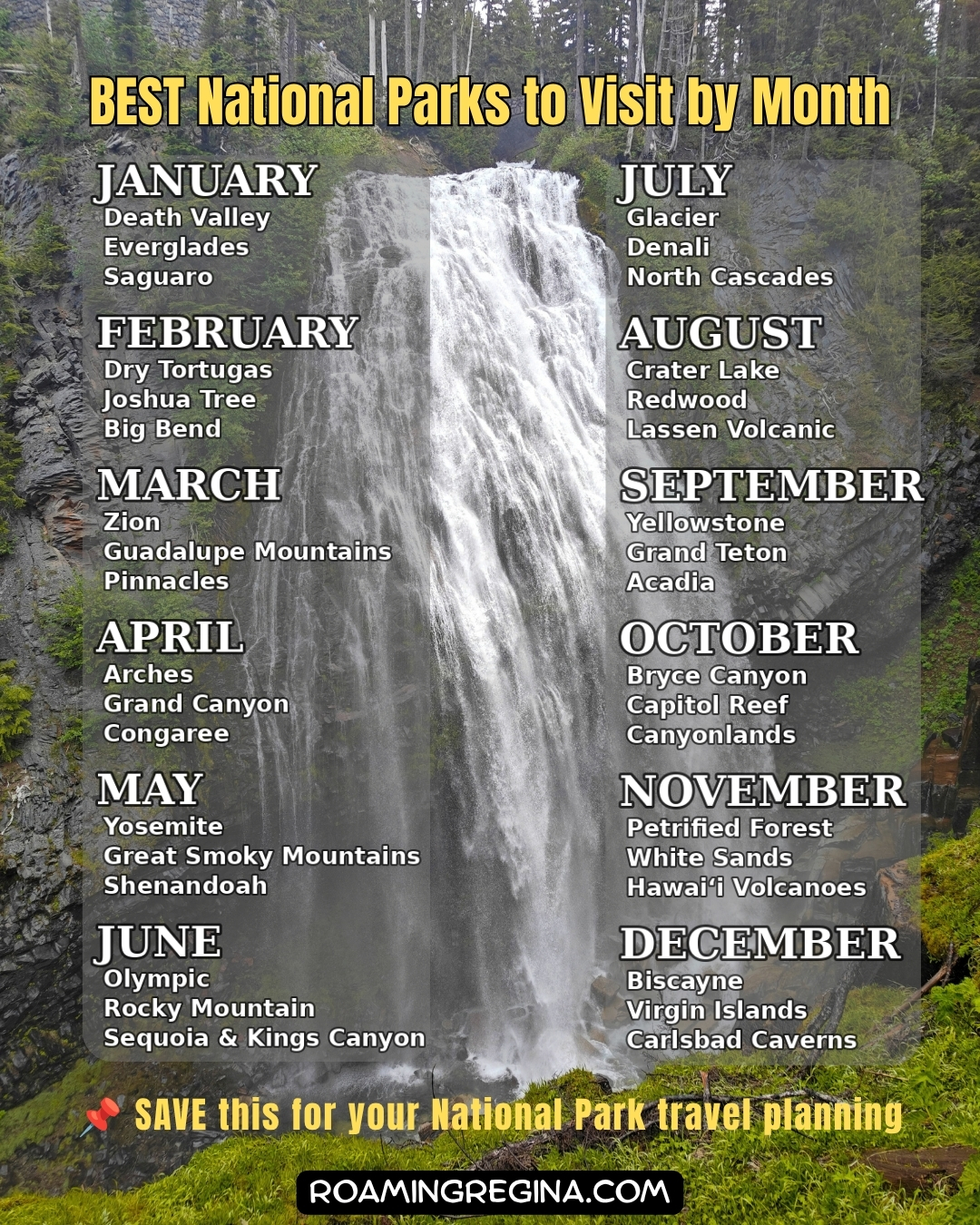
Here are some of the best National Parks to visit each month of the year, based on weather, seasonal highlights, crowds, accessibility, and what makes each park special at that particular time.

January: Death Valley, Everglades & Saguaro
Death Valley National Park, California & Nevada
January is one of the best times to experience Death Valley without its infamous summer heat. Daytime temperatures are much more comfortable for exploring places like Badwater Basin, Zabriskie Point, Mesquite Flat Sand Dunes, and Artist’s Palette.
Winter also brings clearer skies and makes it much easier to spend time outside rather than simply driving between viewpoints.
Everglades National Park, Florida
January falls during South Florida’s dry season, making it an excellent time to visit the Everglades. Humidity is lower, mosquitoes are generally less troublesome, and wildlife viewing can be especially rewarding as animals congregate around remaining water sources.
Don’t miss the Anhinga Trail, one of the easiest places in the park to spot alligators and birds.
👉 Read One Day in Everglades National Park: The Ultimate Itinerary
Saguaro National Park, Arizona
Cool January temperatures make exploring the Sonoran Desert far more comfortable than during the intense summer heat.
Visit both districts of the park if you have time. Saguaro West offers an incredible concentration of giant saguaros, while Saguaro East has a beautiful scenic drive and trails.
February: Dry Tortugas, Joshua Tree & Big Bend
Dry Tortugas National Park, Florida
February offers comfortable temperatures and typically lower humidity for visiting this remote island National Park.
Most visitors arrive by ferry or seaplane from Key West. Once there, you can explore historic Fort Jefferson, snorkel in the clear water, walk the shoreline, and enjoy one of the most unusual National Park experiences in the country.
💡Regina’s Tip: Ferry reservations sell out well in advance, so this isn’t a trip I’d leave until the last minute.
Joshua Tree National Park, California
February brings comfortable daytime temperatures to Joshua Tree, making it a great month for hiking, rock scrambling, scenic drives, and stargazing.
The combination of Joshua trees and enormous rock formations makes this park unlike anywhere else in the National Park system.

👉 Read: One Day in Joshua Tree: The Ultimate High Desert Itinerary
Big Bend National Park, Texas
Winter is prime time in Big Bend. February’s cooler weather makes hiking and exploring the desert much more manageable.
Big Bend is remote, though, so allow plenty of time to get there—and don’t underestimate the distances within the park itself.
March: Zion, Guadalupe Mountains & Pinnacles
Zion National Park, Utah
March can be a sweet spot between winter and the busiest part of Zion’s visitor season.
Temperatures begin warming, although conditions can vary considerably and snow or ice can remain at higher elevations. Check current trail and shuttle conditions before your trip.
Guadalupe Mountains National Park, Texas
March offers pleasant temperatures for exploring this rugged West Texas park before summer heat arrives.
Hikers can tackle Guadalupe Peak—the highest point in Texas—while less strenuous options let you experience the park’s desert landscapes and mountain scenery.
Pinnacles National Park, California
Spring is a wonderful time for Pinnacles. Mild temperatures make hiking more comfortable, wildflowers may begin appearing, and visitors may have a chance to spot California condors soaring overhead.
Planning one of these trips?
🏨 Find places to stay near the National Parks
April: Arches, Grand Canyon & Congaree
Arches National Park, Utah
April offers a fantastic combination of generally pleasant temperatures and longer daylight hours in Arches.
You’ll have plenty of time to see Delicate Arch, Landscape Arch, Balanced Rock and the Windows area without dealing with midsummer temperatures.
👉 Read: Utah National Parks Road Trip: The Ultimate 7-Day Mighty 5 Itinerary
Grand Canyon National Park, Arizona
April is an excellent time to visit the South Rim. Temperatures are generally cooler than summer, and you’re visiting before the peak summer vacation season.
Keep in mind that conditions at the rim can be dramatically different from conditions farther down into the canyon.
Driving the South Rim? I love using GuideAlong on National Park road trips. The audio tour automatically plays stories, tips and information as you drive, so you can explore at your own pace. Check out the Grand Canyon GuideAlong tour.
Congaree National Park, South Carolina
Spring brings lush greenery to Congaree’s floodplain forest before the hottest and most humid part of the year.
Walk the Boardwalk Loop or explore by canoe or kayak for a completely different perspective.
May: Yosemite, Great Smoky Mountains & Shenandoah
Yosemite National Park, California
May is one of my favorite times to recommend Yosemite because of the waterfalls.
As the Sierra Nevada snowpack melts, waterfalls throughout Yosemite Valley can be spectacular. Yosemite Falls, Bridalveil Fall and Vernal Fall are highlights.
Some high-elevation roads and areas may still be closed because of snow, so May isn’t necessarily the month to see everything Yosemite offers. But if waterfalls are your priority, it’s hard to beat.

Great Smoky Mountains National Park, Tennessee & North Carolina
Spring brings wildflowers, green mountainsides and comfortable temperatures to America’s most visited National Park.
Drive Newfound Gap Road, explore Cades Cove, and allow time to simply stop at overlooks along the way.

Shenandoah National Park, Virginia
Skyline Drive is beautiful in spring as the Blue Ridge Mountains turn green again.
With numerous overlooks right along the road, Shenandoah is also a great choice for travelers who want spectacular scenery without doing strenuous hikes.
June: Olympic, Rocky Mountain & Sequoia & Kings Canyon
Olympic National Park, Washington
June begins opening up more of this incredibly diverse park.
In one trip, you can experience mountains, temperate rainforest and the wild Pacific coastline. Hurricane Ridge, Hoh Rain Forest and the beaches along the coast make Olympic feel like several National Parks rolled into one.
Rocky Mountain National Park, Colorado
Early summer brings wildflowers, wildlife and increasingly accessible mountain scenery to Rocky Mountain.
Snow can linger at higher elevations, so always check current conditions before heading onto mountain trails.
Sequoia & Kings Canyon National Parks, California
June is a beautiful time to stand among some of the largest trees on Earth.
Giant Forest and General Sherman are obvious highlights, but leave enough time to slow down and appreciate just how enormous these trees really are.
Don’t Forget Your National Park Gear
Before your trip, check out my National Park travel essentials for some of my favorite things to bring along on park trips. (affiliate link)

July: Glacier, Denali & North Cascades
Glacier National Park, Montana
If Glacier is on your bucket list, July is one of the best opportunities to experience its high-country scenery.
Going-to-the-Sun Road is generally a centerpiece of a Glacier trip once fully open, although opening dates vary each year because of snow.
Glacier requires advance planning. Always check current NPS reservation and access requirements before your trip.

Denali National Park, Alaska
July brings long days and prime summer conditions to Denali National Park. Wildlife is one of the biggest reasons to visit. Keep an eye out for grizzly bears, moose, caribou and Dall sheep as you explore the park.
Denali is different from many National Parks because most visitors don’t simply drive themselves deep into the park. You’ll want to research the current park road conditions and available bus options well before your trip.
And remember: seeing Denali itself is never guaranteed. The mountain frequently hides behind clouds, which makes catching a clear view even more special.
North Cascades National Park, Washington
July is a great time to experience the dramatic mountain scenery of North Cascades. Often called the “American Alps,” this area is filled with jagged peaks, glaciers and brilliant turquoise water. Drive the North Cascades Highway and don’t miss the view overlooking Diablo Lake.
If you enjoy hiking, summer opens up many more opportunities to explore the mountains once the higher-elevation snow begins to melt.
August: Crater Lake, Redwood & Lassen Volcanic
These 3 can be done as one fantastic road trip! 👉Read here: The Ultimate Crater Lake, Redwood, Lassen Volcanic Roadtrip Itinerary
Crater Lake National Park, Oregon
August is one of the best months to visit Crater Lake because summer gives you the best chance of accessing the park’s higher-elevation roads and viewpoints. Crater Lake is the deepest lake in the United States, formed inside the remains of an ancient volcano. Its incredibly blue water is even more impressive in person.
Drive Rim Drive for changing views of the lake, stop at the overlooks and, if conditions allow, consider taking a boat tour for an entirely different perspective. Even in summer, weather can change quickly at this elevation, so bring layers.
Redwood National and State Parks, California
Walking beneath the world’s tallest trees is one of those National Park experiences that’s difficult to appreciate until you’re actually standing there.
August is a great time to combine the towering redwood forests with Northern California’s rugged coastline.
Take a scenic drive, walk among the old-growth redwoods and keep an eye out for Roosevelt elk. Give yourself enough time here—Redwood isn’t one single park entrance and visitor center. The National and State Parks cover a large area along the coast.
Lassen Volcanic National Park, California
Lassen’s relatively short summer season makes August an excellent time to explore this fascinating volcanic landscape.
You’ll find mountain lakes and beautiful scenery alongside hydrothermal features such as steaming fumaroles and bubbling mud pots.
Bumpass Hell is one of the park’s best-known hydrothermal areas, while Lassen Volcanic National Highway provides access to numerous overlooks and trailheads.
Because snow can affect access well into the year, summer is your best opportunity to experience more of the park.
September: Yellowstone, Grand Teton & Acadia
Yellowstone National Park, Wyoming, Montana & Idaho
September can be fantastic in Yellowstone. Summer crowds begin declining, temperatures cool and wildlife remains a major attraction.
You still get Yellowstone’s iconic geothermal features—Old Faithful, Grand Prismatic Spring and Mammoth Hot Springs—but with the feel of early fall beginning to settle over the park.
Grand Teton National Park, Wyoming
September brings crisp mornings and the beginning of fall color beneath the Teton Range.
Wildlife viewing can also be excellent. Combining Yellowstone and Grand Teton makes an outstanding National Park road trip.
Acadia National Park, Maine
September is a wonderful time to experience Acadia after the busiest part of the summer season.
Drive Park Loop Road, see Jordan Pond, explore the rocky coastline and spend some time walking Ocean Path. Cadillac Mountain is another Acadia highlight, especially if you can catch a clear morning.
September is also a great transition into Maine’s fall season. Exact foliage timing varies from year to year, so don’t plan a September visit expecting guaranteed peak color.
Acadia is especially appealing if you’re looking for a National Park that offers plenty of beautiful scenery without requiring strenuous hiking
I’m a big fan of GuideAlong audio tours and they have an Acadia National Park tour that you will want to play as you drive the park.
October: Bryce Canyon, Capitol Reef & Canyonlands
These 3 also make up part of an epic roadtrip! 👉 Read: Utah National Parks Road Trip: The Ultimate 7-Day Mighty 5 Itinerary
Bryce Canyon National Park, Utah
Cooler October temperatures are ideal for exploring Bryce Canyon’s famous hoodoos.
Sunrise over the Bryce Amphitheater is worth getting up early for, and trails such as Navajo Loop and Queen’s Garden let you leave the rim and experience the hoodoos from an entirely different perspective.
Don’t let the desert scenery fool you about the temperatures, though. Bryce Canyon sits at a high elevation, so October mornings and evenings can be quite cold.

Capitol Reef National Park, Utah
Capitol Reef sometimes gets overshadowed by Utah’s better-known National Parks, but don’t skip it.
October’s comfortable temperatures make it a great time to explore the Waterpocket Fold, take a scenic drive and spend some time in the historic Fruita district.
Capitol Reef also provides a completely different experience from Bryce Canyon, making the two parks a great combination on a Utah road trip.
Canyonlands National Park, Utah
October brings much more comfortable temperatures for exploring Canyonlands’ enormous desert landscape.
If it’s your first visit, Island in the Sky is an excellent place to start. It’s the park’s most accessible district and offers spectacular overlooks with relatively little walking required.
Mesa Arch is one of the park’s best-known stops, while Grand View Point gives you a sense of just how vast Canyonlands really is.
Canyonlands also pairs naturally with nearby Arches National Park and Moab, making October an excellent month for a longer Utah National Parks trip.
November: Petrified Forest, White Sands & Hawaiʻi Volcanoes
Petrified Forest National Park, Arizona
Cooler temperatures make November a comfortable month for exploring Petrified Forest’s colorful badlands and ancient petrified wood.
Don’t make the mistake of thinking this park is only about logs—the Painted Desert scenery is a huge part of the experience.
White Sands National Park, New Mexico
The brilliant white gypsum dunes are gorgeous year-round, but cooler November temperatures make exploring them much more pleasant.
Stay for sunset if you can. The changing light over the dunes can be spectacular.
Hawaiʻi Volcanoes National Park, Hawaiʻi
Hawaiʻi is a wonderful escape as temperatures cool across much of the mainland.
Volcanic conditions can change at any time, so check the National Park Service’s current alerts before visiting rather than planning a trip around seeing active lava.
December: Virgin Islands, Biscayne & Carlsbad Caverns
Virgin Islands National Park, U.S. Virgin Islands
December begins the Caribbean’s popular winter travel season.
Beaches, snorkeling and tropical landscapes make Virgin Islands National Park quite the contrast to December weather across much of the mainland.
Biscayne National Park, Florida
Most of Biscayne is water, so the best way to experience this park is on the water, rather than simply stopping at the visitor center.
Boat tours, snorkeling and paddling let you experience coral reefs, mangroves and Biscayne Bay.
👉 Read: Biscayne National Park: How to See Boca Chita Key Lighthouse Without a Boat

Carlsbad Caverns National Park, New Mexico
Carlsbad Caverns makes a great winter National Park destination because its main attraction isn’t dependent on warm outdoor weather.
Walk into the cavern through the Natural Entrance if you’re able, then explore the enormous Big Room below ground.
So, When Is the Best Time to Visit the National Parks?
The answer depends entirely on which National Park you’re visiting.
Summer is perfect for parks with short high-elevation seasons like Glacier and North Cascades, while winter opens up comfortable opportunities in desert parks such as Death Valley and Saguaro. Spring brings Yosemite’s waterfalls, and fall can mean spectacular scenery in Yellowstone, Grand Teton and Great Smoky Mountains.
That’s one of my favorite things about working toward visiting all 63 National Parks: there’s almost always somewhere that’s entering its best season.
Save this guide and come back to it whenever you’re trying to decide where your next National Park trip should take you.
Want to visit all 63 U.S. National Parks?
Download my FREE Visit All 63 National Parks Tracker and start checking them off one by one.
Safe Travels,
Regina


