
This post may contain affiliate links. If you make a purchase through one of these links, I may earn a small commission at no additional cost to you. Thank you for supporting Roaming Regina and helping me continue sharing National Park travel tips!
When you think of spring break, crowded beaches may be the first thing that comes to mind. But I’d argue that spring break is also one of the best times of year to plan a National Park trip.
March and April arrive right in the sweet spot for many of America’s desert and southern parks. Temperatures that can become brutally hot during summer are much more comfortable, wildflowers may start blooming, wildlife is active, and several parks are perfect for a long weekend or week-long road trip.
And if your goal is to eventually Visit All 63 U.S. National Parks, spring break is a great opportunity to knock another park (or two or three) off your list.
FREE NATIONAL PARKS TRACKER:
Working toward all 63? Download my free 63 U.S. National Parks Tracker and keep track of every park you’ve visited.

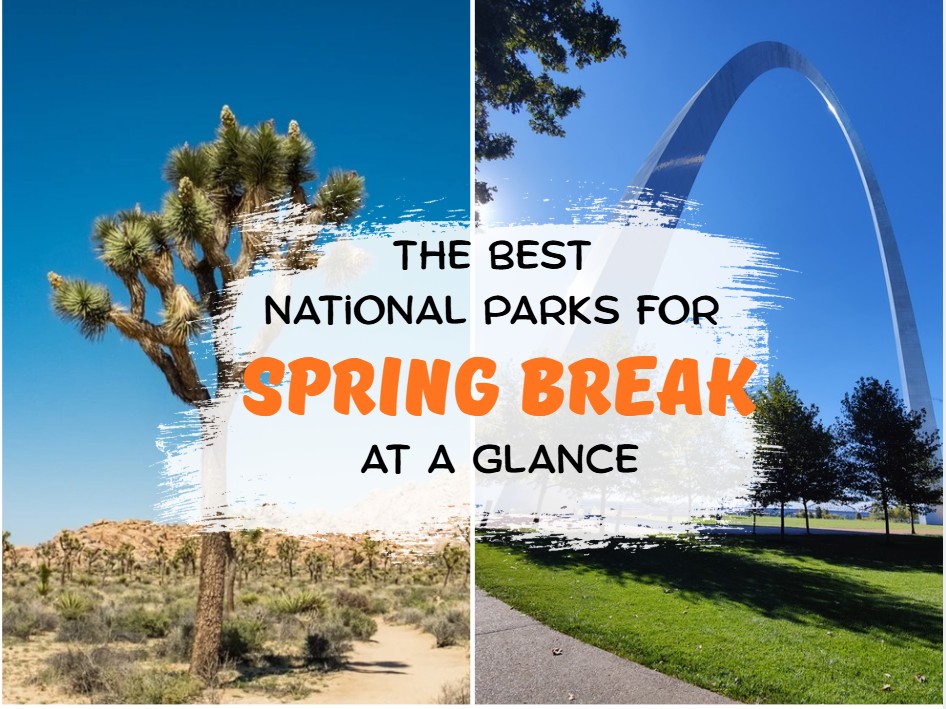
The Best National Parks for Spring Break at a Glance
| National Park | Best For | Best Spring Timing | Good Home Base |
|---|---|---|---|
| Zion | Iconic scenery + hiking | March–April | Springdale, Utah |
| Arches | Red rocks + road trip | Late March–April | Moab, Utah |
| Joshua Tree | Desert landscapes | March–April | Joshua Tree / Palm Springs |
| Saguaro | Cacti + wildflowers | March–April | Tucson, Arizona |
| Death Valley | Dramatic desert scenery | March–early April | Furnace Creek / Pahrump |
| Everglades | Wildlife | March–April | Homestead / Everglades City |
| Big Bend | Remote adventure | March | Terlingua / Marathon |
| Grand Canyon | Bucket-list views | April | Tusayan, Arizona |
| Great Smoky Mountains | Wildflowers + waterfalls | April | Gatlinburg / Townsend |
| White Sands | Unique scenery + families | March–April | Alamogordo, New Mexico |
| BONUS: Gateway Arch | City getaway + easy park visit | March–April | St. Louis, Missouri |
One important spring-break warning: March and April are busy at many of these parks. Reserve accommodations early and always check the National Park Service website shortly before your trip for current weather, road closures, permits and reservation requirements.
1. Zion National Park, Utah
If you want a spring-break trip with an immediate WOW factor, Zion is hard to beat. Massive sandstone walls rise above Zion Canyon, and some of the park’s most famous scenery can be reached without spending the entire day hiking.
Spring brings warming daytime temperatures, budding trees and early wildflowers, although nights can still be cold. Snowmelt can also raise the Virgin River enough that the Narrows may temporarily close.
Don’t Miss
- Canyon Overlook Trail
- Pa’rus Trail
- Emerald Pools
- Riverside Walk
- Court of the Patriarchs
- Zion Canyon scenic viewpoints
💡Regina’s Tip: Spring shuttle service normally returns to Zion Canyon during this period, so check the current schedule before your trip.
Where to Stay
Springdale is by far my favorite base for Zion because you’re right outside the park entrance and can use the town shuttle when it’s operating.
Make the Drive More Interesting!
Want a guide without joining a tour group? I love the concept behind GuideAlong because the commentary automatically plays as you drive. Their Zion + Bryce Canyon tour shares stories, history and tips as you travel through the parks…and you can still explore completely on your own schedule!
Read my post Utah National Parks Road Trip: The Ultimate 7-Day Mighty 5 Itinerary
2. Arches National Park, Utah
Want to turn spring break into a two-park vacation? Base yourself in Moab and visit both Arches National Park and Canyonlands National Park.
Arches has more than 2,000 documented natural stone arches along with towering fins, balanced rocks and some of Utah’s most recognizable scenery. Spring is one of the park’s most comfortable seasons although nights can be chilly.
Don’t Miss
- Delicate Arch
- The Windows
- Double Arch
- Balanced Rock
- Park Avenue
- Landscape Arch
Spring is also one of Arches’ busiest periods, and entrance waits between March and October can be significant.
Stay a Few Days
Stay in Moab and give yourself at least one day for Arches and another for Canyonlands.
Make the Drive More Interesting!
I mentioned above that I’m a big fan of GuideAlong and they also offer an Arches + Canyonlands driving tour that you should check out!
Want Someone Else to Do the Driving?
Prefer to leave the driving and planning to someone else? There are also guided Arches tours from Moab, including scenic van and small-group options. Viator currently lists numerous Arches experiences based in Moab.

3. Joshua Tree National Park, California
Joshua Tree feels like you’ve landed on another planet. Its twisted namesake trees, enormous boulder piles and wide-open desert make it completely different from most National Parks — and spring is one of the most comfortable seasons to see it. I visited this one in March and it was perfect!
Typical spring temperatures are considerably more pleasant than summer, and wildflowers can appear at different elevations throughout the season. Lower elevations can begin blooming earlier, while some areas between about 3,000 and 5,000 feet commonly bloom from early March into early May. Exactly how good the flowers will be depends heavily on rainfall and weather conditions.
Don’t Miss
- Hidden Valley
- Skull Rock
- Keys View
- Barker Dam
- Cholla Cactus Garden
- Arch Rock
Joshua Tree is especially easy to combine with a few days in Palm Springs, which makes it a nice National Park + resort-style spring break.
Read my post: One day in Joshua Tree: The Ultimate High Desert Itinerary
Where to Stay
Use either Joshua Tree/Twentynine Palms for a park-focused trip or Palm Springs if you want restaurants, resorts and a pool.
Make the Drive More Interesting!
GuideAlong has a dedicated Joshua Tree driving tour with more than 185 audio points and routes from Palm Springs, Los Angeles, Las Vegas and Phoenix.
Want Someone Else to Do the Driving?
4. Saguaro National Park, Arizona
If your idea of a spring break involves sunshine and giant cactus instead of snow, put Saguaro National Park on your list. The park surrounds Tucson in two separate districts, giving you miles of desert scenery filled with the giant saguaros Arizona is famous for. March can also bring spring wildflowers. The park says blooms are often at their best around mid-to-late March, although conditions vary considerably from year to year. Cactus-flower season becomes more prominent in April and May.
Don’t Miss
- Cactus Forest Drive
- Bajada Loop Drive
- Signal Hill
- Desert Discovery Nature Trail
- Sunset among the saguaros
This is a particularly good choice for travelers who don’t want their entire vacation to revolve around long hikes.
Make It a Tucson Vacation
Stay in Tucson, explore the park during the day, then enjoy the restaurants and other attractions in the city.
Looking for a place to stay? Explore hotels and other accommodations in Tucson below:
5. Death Valley National Park, California
Ignore the intimidating name for a minute. Spring is exactly when you want to experience Death Valley. Average highs at Furnace Creek climb from about 82°F in March to around 90°F in April, meaning earlier spring trips generally offer far more comfortable conditions than summer.
And after the right combination of winter rain and temperatures, wildflowers can appear across the desert. Lower-elevation blooms generally occur first, from roughly mid-February through mid-April, although flower displays vary dramatically from year to year.
Don’t Miss
- Badwater Basin
- Zabriskie Point
- Artist’s Palette
- Mesquite Flat Sand Dunes
- Dante’s View
A Park Made for an Audio Tour
Death Valley is enormous, which makes this another park where I recommend GuideAlong. Their Death Valley tour covers stops including Badwater Basin, Artist’s Palette, Dante’s View, Mesquite Flat Sand Dunes, Ubehebe Crater and Zabriskie Point
Where to Stay
Consider staying inside Death Valley if you can, or use Pahrump depending on your route.
6. Everglades National Park, Florida
If your priority is wildlife, Everglades National Park deserves a spot near the top of your list. December through April is generally the Everglades’ dry season, when conditions tend to be less humid, mosquitoes are typically less intense and wildlife viewing can be excellent.
Don’t Miss
- Anhinga Trail
- Shark Valley
- Flamingo
- Wildlife watching
- A boat or airboat experience
The Everglades is also different from many National Parks because the experience isn’t primarily about hiking. That can make it a particularly nice spring-break choice for families or mixed groups where everyone has different activity levels.
Want to experience the Everglades from the water?
Airboat and wildlife tours are one of the most popular ways to explore South Florida’s wetland ecosystem. Viator offers multiple Everglades airboat and wildlife tours.
Where to Stay
Depending on which section you visit, look at Homestead/Florida City, Everglades City or Miami.

7. Big Bend National Park, Texas
For a spring break that feels more like an actual escape, head to Big Bend National Park. Big Bend combines mountains, desert and the Rio Grande in one enormous and remote park. March is typically warm and pleasant — but there’s a catch: it’s also the park’s busiest season, and mid-January through mid-April can fill lodging and campgrounds. This is one park where I would book accommodations well ahead of spring break.
Don’t Miss
- Santa Elena Canyon
- Ross Maxwell Scenic Drive
- Chisos Basin
- Window View
- Rio Grande Village
💡Regina’s Tip: Don’t underestimate the distances. Big Bend is huge, services are spread out and fuel, food and water require more planning than at many National Parks.
Where to Stay
Look at lodging in Terlingua or Marathon.
8. Grand Canyon National Park, Arizona
There is never a bad excuse to see the Grand Canyon. But spring break comes with one important reality: The Grand Canyon is high elevation. If you visit the South Rim in March or early April, don’t assume you’re heading to warm Arizona sunshine. Snow and icy conditions remain possible into spring, and the North Rim normally remains seasonally closed until later in the year.
For me, that doesn’t remove Grand Canyon from a spring-break list. It just means you need to pack differently.
Don’t Miss
- Mather Point
- Yavapai Point
- Desert View
- Grand Canyon Village
- Rim Trail
- Sunrise or sunset
Make the Drive More Interesting!
GuideAlong’s South Rim tour includes commentary through the Village and rim-area drives.
Where to Stay
Tusayan is convenient to the South Entrance.
9. Great Smoky Mountains National Park, Tennessee & North Carolina
If your spring break falls in April rather than early March, Great Smoky Mountains National Park becomes especially appealing. Spring weather here is much less predictable than the desert Southwest. Snow is still possible in March, especially at higher elevations, while lower elevations generally become much milder by mid-April. April also brings spring showers and wildflowers.
Don’t Miss
- Cades Cove
- Newfound Gap
- Little River Road
- Waterfalls
- Historic buildings
- Spring wildflowers
💡Regina’s Tip: This is another good choice for mixed groups because you can see a tremendous amount from scenic drives and short walks.
Where to Stay
Choose Gatlinburg for restaurants and attractions or Townsend for something quieter.
10. White Sands National Park, New Mexico
Want one of the most unusual spring-break landscapes anywhere in the National Park system? Head to White Sands. Miles of brilliant white gypsum dunes create a landscape that looks more like snow than desert – except you can climb the dunes and even sled down them. March through May daytime temperatures average about 75°F overall, although spring can also bring powerful winds, so checking the daily forecast is particularly important here.
Don’t Miss
- Dunes Drive
- Interdune Boardwalk
- Dune Life Nature Trail
- Dune sledding
- Sunset
This one is particularly fun if you’re traveling with kids…although I know plenty of adults who’d happily spend the afternoon sledding down a giant white dune too.
Where to Stay
Alamogordo makes a great nearby base.
Bonus: Gateway Arch National Park, Missouri
Not every spring break National Park trip has to involve hiking boots and a week-long road trip. The Gateway Arch National Park is a great bonus option if you want an easy city getaway that still lets you add another National Park to your 63. Located right in downtown St. Louis, this is one of the most accessible parks on the list and you can experience the highlights in a day or build an entire weekend around it.
As someone who lived in St. Louis for over 20 years, I can tell you spring is a particularly nice time to visit. March and April bring the first blooms to the park grounds, including magnolia and redbud trees, and while spring break does bring an increase in visitors, it’s less than summer.
Don’t Miss
- Ride the tram to the top of the Gateway Arch
- Explore the museum beneath the Arch
- Visit the historic Old Courthouse
- Walk the landscaped park grounds and riverfront
- Take in the view of downtown St. Louis and the Mississippi River
💡Regina’s Tip: The museum beneath the Arch and the Old Courthouse are free to visit. The Tram Ride to the Top requires a ticket, and advance reservations are a good idea, especially during spring break.
Why It Works for Spring Break
Gateway Arch is a particularly good option if you:
- Only have a long weekend
- Don’t want a hiking-focused trip
- Are traveling with kids or a mixed-age group
- Want to combine a National Park with restaurants, museums and other city attractions
- Are working toward visiting all 63 and want a park that’s easy to incorporate into another trip
Where to Stay
Stay in downtown St. Louis and you can make the Arch part of a larger city weekend.

What to Pack for a National Park Spring Break
Spring can be one of the trickiest seasons to pack for because you might encounter 80-degree desert sunshine one day and freezing temperatures at a higher-elevation park the next.
I always recommend checking the actual forecast shortly before departure rather than packing based solely on average temperatures.
For most spring National Park trips, consider bringing:
- Layers, including a lightweight fleece or jacket
- Comfortable hiking or walking shoes
- Refillable water bottle
- Small daypack
- Sunscreen
- Sunglasses
- Sun hat
- Portable phone charger
- Binoculars for wildlife
- Trekking poles if you’ll be hiking
- Offline park maps
🏞️ Shop My National Park Travel Essentials
I’ve put together my favorite National Park road-trip and hiking gear in my Amazon Storefront, including the items I use to make park days easier.
How to Choose the Best National Park for Your Spring Break
If you’re still deciding, start with the kind of trip you want.
For warm weather: Saguaro, Everglades, Joshua Tree or Death Valley.
For spectacular hiking and red rocks: Zion or Arches.
For wildlife: Everglades or Great Smoky Mountains.
For an iconic first National Park trip: Grand Canyon or Zion.
For a more unusual experience: White Sands.
For a remote road-trip adventure: Big Bend.
And if you have a full week, think about combining parks rather than flying across the country for just one. Moab makes it easy to visit Arches + Canyonlands. Southern Utah can turn into a larger Mighty 5 road trip. A Southern California trip can combine Joshua Tree + Death Valley, while an Arizona trip could potentially include Grand Canyon + Saguaro depending on how much driving you’re willing to do.
Every trip gets you one step closer to seeing all 63.
Your 63 National Parks journey
Whether spring break takes you to your first National Park or your 40th, there’s something very satisfying about adding another one to your list. If visiting all 63 sounds like your kind of travel goal, grab my Free 63 U.S. National Parks Tracker.
And if you can’t make it to a National Park every month, I can bring one to you! The Visit All U.S. National Parks Mail Club is a mini National Park experience delivered through the mail each month.
One park at a time, we’re working our way through all 63. ❤️
Keep exploring,


