
This post may contain affiliate links, which means I may earn a small commission at no extra cost to you if you make a purchase through my links. As an Amazon Associate, I earn from qualifying purchases.
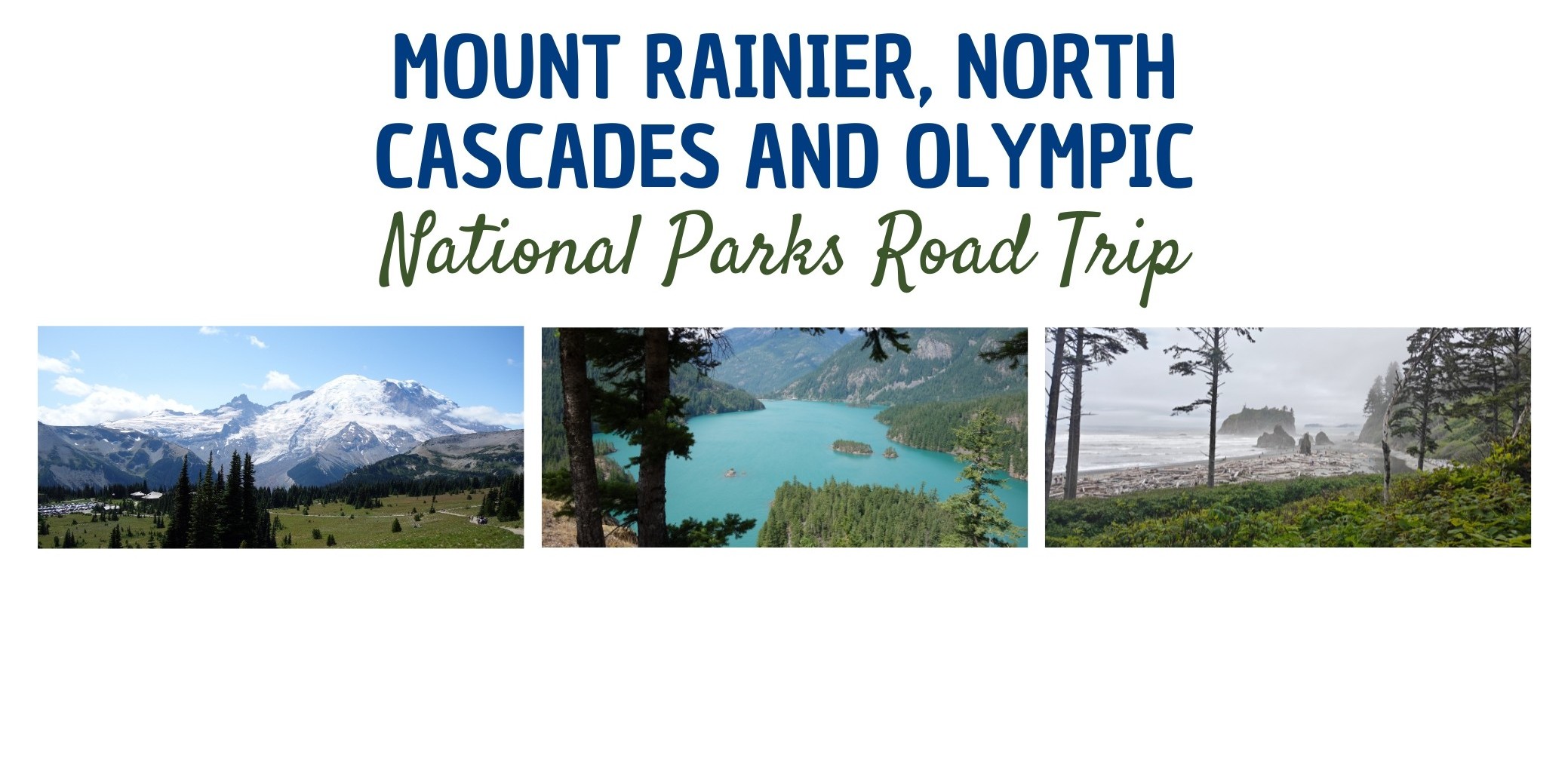
Glacier-covered peaks, turquoise mountain lakes, moss-draped rain forests and wild Pacific beaches all belong to the same Washington national parks road trip.
Looking to Visit Multiple National Parks in One Trip?
This Washington national parks road trip connects Mount Rainier, North Cascades and Olympic National Parks into one unforgettable 10-day adventure. These 3 parks are close enough to visit in one vacation, but different enough that each one feels like an entirely new destination. In ten days, you can:
- 🏔️ Hike at Mount Rainier
- 💙 Follow the North Cascades Highway past brilliant blue lakes
- 🌿 Wander through the Hoh Rain Forest
- 🌅 Watch the sun set behind Olympic’s sea stacks
This itinerary begins and ends in Seattle, WA and gives each park enough time to experience its highlights without turning every day into a race.
💡Tip: Drive times in Washington can change because of traffic, ferries, construction, weather and seasonal road closures. Always check current park and road conditions shortly before your trip.
Washington National Parks Road Trip at a Glance
- National Parks: Mount Rainier, North Cascades and Olympic
- Start and finish: Seattle or Seattle-Tacoma International Airport
- Ideal trip length: 10 days
- Best time: Late July through mid-September
- Approximate driving: 800–900 miles, depending on lodging and optional detours
- Route: Seattle → Mount Rainier → North Cascades → Olympic → Seattle
Quick 10-Day Itinerary
| Day | Destination | Main experiences |
|---|---|---|
| 1 | Seattle to Mount Rainier | Pick up rental car, drive to Ashford |
| 2 | Mount Rainier: Paradise | Myrtle Falls, Skyline Trail, Reflection Lakes |
| 3 | Mount Rainier: Sunrise | Sunrise views and trails, Tipsoo Lake |
| 4 | North Cascades | Drive north, visitor center and short forest walks |
| 5 | North Cascades Highway | Gorge Creek Falls, Diablo Lake, Ross Lake |
| 6 | North Cascades to Olympic | Port Townsend–Coupeville ferry, Port Angeles |
| 7 | Olympic: Mountains and lake | Hurricane Ridge, Lake Crescent, Marymere Falls |
| 8 | Olympic: Rain forest and coast | Hoh Rain Forest and Rialto Beach |
| 9 | Olympic: Southern coast | Ruby Beach, Kalaloch and Lake Quinault |
| 10 | Return to Seattle | Drive to Seattle |
Why This Route Works
Washington’s three national parks form a large loop around Seattle. Visiting Mount Rainier first, then North Cascades and Olympic, keeps the longest travel days manageable and avoids unnecessary backtracking.
It also places the Port Townsend–Coupeville ferry between North Cascades and Olympic. The ferry shortens the drive around Puget Sound and turns what could feel like a transfer day into part of the adventure.
Olympic comes last because its mountains, rain forests and coast require several different entrance roads and lodging bases. There is no road across the center of the park, so trying to see Olympic from one hotel adds hours of repeated driving.
🚗 Gear Up for Your Washington National Parks Road Trip
With plenty of driving between Mount Rainier, Olympic, and North Cascades, a few good road-trip essentials can make the trip a lot easier. I’ve put together the car and travel gear I like having along for National Park road trips.

Day 1: Seattle to Mount Rainier National Park
Pick up your rental car at Seattle-Tacoma International Airport and drive toward the Nisqually Entrance of Mount Rainier National Park. Plan on roughly two hours to reach Ashford, depending on traffic.
If you arrive early enough, continue into the park to Longmire. Walk the short Trail of the Shadows, visit the Longmire Museum or just relax and enjoy your first close views of the mountain.
Stay in Ashford or near the Nisqually Entrance for the next two nights. This puts you in the best position for an early start at Paradise.
Where to stay: Ashford, Longmire or near the Nisqually Entrance
Driving: Approximately 80–100 miles
💡Tip: If you see roadside stands selling Rainier Cherries stop and get some! Rainier cherries are known for their sweetness and distinct golden yellow appearance. They are one of my favorite snacks!

Day 2: Explore Paradise at Mount Rainier
Paradise is the classic Mount Rainier experience: wildflower meadows, waterfalls, glaciers and some of the closest road-accessible views of the mountain.
💡Tip: Arrive early because parking fills quickly.
Choose the hike that best fits your group:
- Myrtle Falls: About 1 mile round trip and one of the park’s most recognizable views.
- Nisqually Vista Trail: A 1.2-mile loop with views of the Nisqually Glacier.
- Skyline Trail: A strenuous 5.5-mile loop with approximately 1,700 feet of elevation gain. It passes Myrtle Falls, Glacier Vista and Panorama Point.
After hiking, follow Stevens Canyon Road toward Reflection Lakes, Louise Lake and Box Canyon if time and road conditions allow. Stop at Narada Falls on the way to or from Paradise.
Return to Ashford for the night.
Don’t miss: Myrtle Falls with Mount Rainier rising behind it
Best for an easier day: Nisqually Vista Trail plus Myrtle Falls
Best for hikers: The full Skyline Trail

Day 3: Sunrise, Tipsoo Lake and Mount Rainier’s East Side
Check out of your Ashford lodging and drive across the park toward Sunrise. The route is scenic – allow plenty of time for overlooks, traffic and mountain roads. At 6400 feet, Sunrise is the highest point in Mount Rainier National Park that you can reach by vehicle. On a clear day, the views stretch across the Cascade Range.
Good trail choices include:
- Sunrise Nature Trail: A 1.5-mile loop through subalpine meadows.
- Emmons Vista Overlooks: Approximately 1 mile round trip for views of Emmons Glacier.
- Frozen Lake Loop: About 3 miles round trip.
- Mount Fremont Lookout: A longer, more challenging hike with expansive mountain views.
After leaving Sunrise, stop at Sunrise Point and Tipsoo Lake. If wildflowers are blooming, the short walk around Tipsoo Lake is especially beautiful.
Where to stay: Greenwater or Enumclaw. This positions you for the trip north the next morning.
💡Tip: Sunrise Road is seasonal and generally opens later than lower-elevation areas so make sure you check before you go

Planning more than a quick stop at Rainier? I created a 34-page first-time visitor guide with 1- and 2-day itineraries, hikes, lodging, parking tips and more.
Day 4: Drive to North Cascades National Park
Today is mostly a travel day. Drive north toward Marblemount, WA and the State Route 20 corridor. Depending on your starting point and traffic, allow roughly four hours before stops. If you reach Newhalem with time to explore, visit the North Cascades Visitor Center and walk to the Sterling Munro Overlook. Other easy options include the River Loop Trail or the Trail of the Cedars.
💡Tip: Stock up on food and fuel before heading deeper into the park corridor. Services become limited east of Marblemount.
Where to stay: Marblemount for convenience or Burlington for more services
Driving: Approximately 170–200 miles, depending on your lodging
Day 5: Drive the North Cascades Highway
State Route 20—better known as the North Cascades Highway—is the centerpiece of today’s adventure. The road winds between forested valleys, glacier-cut peaks and striking blue-green reservoirs. Allow the entire day as you will want time for overlooks, walks and plenty of photos.
Recommended stops include:
- Gorge Creek Falls – Walk the short interpretive trail for views of the waterfall, gorge and dam.
- Diablo Lake Overlook – This is one of the most famous views in the North Cascades. The lake’s turquoise color comes from fine glacial sediment suspended in the water.
- Thunder Knob Trail – For a moderate hike with a big payoff, Thunder Knob is approximately 1.9 miles round trip with 680 feet of elevation gain and views over Diablo Lake.
- Ross Lake Overlooks – Stop for views across Ross Lake and the surrounding peaks.
- Washington Pass Overlook – Continue beyond the national park complex to Washington Pass for one of the most dramatic roadside mountain views in Washington.
Return to your lodging on the west side of the park so you are positioned for the trip to Olympic the next day.
Optional Hiker’s Alternative: Cascade Pass
Experienced hikers can dedicate this day to Cascade Pass instead. The trail is 7.4 miles round trip with 1,700 feet of elevation gain and leads to sweeping views of peaks and glaciers. Access requires driving more than 20 miles on Cascade River Road, much of it gravel, narrow and rough. The road and trail can remain snow-covered into summer, so check current conditions and rental-car restrictions before choosing this option.

Day 6: North Cascades to Olympic National Park
Leave the North Cascades area and drive west. If time allows, stop at Deception Pass State Park before continuing to the Coupeville ferry terminal.
Take the Coupeville–Port Townsend ferry across Puget Sound, then drive to Port Angeles, WA. Vehicle reservations are recommended on this ferry route. Arrive early enough to check in before your sailing, and allow extra time in case weather, tides or ferry schedules affect the crossing.
If you reach Port Angeles early, stop at the Olympic National Park Visitor Center or walk along the waterfront.
Where to stay: Port Angeles
Day 7: Hurricane Ridge, Lake Crescent and Marymere Falls
Olympic National Park protects three completely different environments:
- glacier-carved mountains
- temperate rain forests
- a rugged Pacific coastline
Today begins in the mountains. Drive to Hurricane Ridge early. On a clear day, the ridge offers sweeping views of the Olympic Mountains and across the Strait of Juan de Fuca toward Vancouver Island. Take a short walk near the ridge or choose a longer trail if conditions and time allow.
💡Tip: Because clouds can hide the views, check the park webcam before driving up Hurricane Ridge.
Next, drive west to Lake Crescent. The deep, clear lake is surrounded by steep forested mountains and is one of Olympic’s most peaceful landscapes. Walk to Marymere Falls, enjoy the lakefront near Lake Crescent Lodge or take the short Moments in Time Trail.
Drive to Forks to check in to your next hotel.
💡Tip: If you are a Twilight fan, check out some Forks locations from the book / movie.
Recommended overnight: Forks, WA
Don’t miss: Hurricane Ridge on a clear morning and Lake Crescent in the afternoon

Day 8: Hoh Rain Forest and Rialto Beach
Leave Forks early and drive to the Hoh Rain Forest. In summer, the entrance line can stretch for an hour or two once the parking area fills. Try to arrive before 8 a.m. or wait until late afternoon.
Start with the Hall of Mosses, an easy 0.8-mile loop beneath maples draped in moss. Add the Spruce Nature Trail, a 1.2-mile loop through old-growth forest and along the Hoh River.
After the rain forest, return toward Forks and continue on to Rialto Beach. Massive driftwood logs, crashing waves and offshore sea stacks make it feel completely different from the mountain scenery earlier in the trip.
If low tide falls at the right time, hike north toward Hole-in-the-Wall. The arch is 1.5 miles from the Rialto Beach trailhead. Check the tide chart before leaving, arrive at least 30 minutes before the lowest tide and never let the incoming tide trap you beyond an impassable headland.
Return to Forks for the night.
Where to stay: Forks
Best timing: Hoh early in the morning and Rialto Beach near sunset or low tide

Day 9: Ruby Beach, Kalaloch and Lake Quinault
Check out of your Forks lodging and continue south along Highway 101 to Ruby Beach. Walk down to the shore to see sea stacks, driftwood and the wild Pacific coastline.
Then visit the Kalaloch area. Stop at the Tree of Life if it is safe and accessible, walk one of the numbered beaches or time your visit for low-tide tidepooling at Beach 4.
💡Tip: Never climb on driftwood near the water. Powerful waves can move even enormous logs without warning.
Finish the day at Lake Quinault, where you can take a short forest walk, follow part of the Quinault Rain Forest scenic loop or just relax by the lake. Stay near Lake Quinault for your final night. This breaks up the drive to Seattle and lets you experience another side of Olympic without backtracking.
Where to stay: Lake Quinault
Don’t miss: Ruby Beach and an evening beside Lake Quinault
Day 10: Lake Quinault to Seattle
Enjoy a final morning walk around Lake Quinault before driving back to Seattle. The drive usually takes about three hours without long stops, but traffic can add time. If you are flying home, consider staying in Seattle tonight rather than booking a flight that requires a rushed departure from the peninsula.
If you have extra days to stay in Seattle, you can take the Seattle City Highlights Tour for an easy way to see the highlights without worrying about driving and parking.

Best Time for This Washington National Parks Road Trip
The best window for this exact itinerary is late July through mid-September.
By late July, the highest seasonal roads and many alpine trails are more likely to be open and snow-free. Wildflowers often bloom at Mount Rainier in late July and August, while September brings cooler temperatures and somewhat lighter crowds.
Month-by-Month Overview
- June: Waterfalls are strong and lower trails are green, but Sunrise Road, North Cascades Highway trails and high-elevation hikes may still have snow.
- Late July and August: Best access to the complete route, but also the busiest period. Reserve lodging and campgrounds early.
- September: Often an excellent balance of open roads, cooler weather and fewer families traveling after school begins. Wildfire smoke and early snow are still possible.
- October through spring: Not recommended for this full itinerary because Sunrise Road and the North Cascades Highway are seasonal, and weather can limit Hurricane Ridge access.
Reservations, Fees and 2026 Planning Updates
These details are current for 2026:
- Mount Rainier: No timed-entry reservation is required anywhere in the park in 2026. Parking management is still in effect, and popular lots may fill.
- Mount Rainier construction: The Ohanapecosh developed area is closed during the 2026 construction season, and Grove of the Patriarchs remains closed.
- Olympic: No general timed-entry reservation is required, but Hurricane Ridge and the Hoh Rain Forest can have entrance waits of up to two hours during busy summer periods.
- North Cascades: There is no entrance fee for North Cascades National Park Service Complex. State Route 20 is seasonal and can also close temporarily because of fire, snow or road conditions.
- Ferry: Vehicle reservations are recommended for the Port Townsend–Coupeville route.
- Park pass: Mount Rainier and Olympic each charge a vehicle entrance fee (use your America the Beautiful pass if you have one). North Cascades has no entrance fee.
Tips for Planning Your Washington National Parks Road Trip
- Start Early – The most popular parking lots and entrance roads fill in summer. Early starts matter most at Paradise, Sunrise, Hurricane Ridge and the Hoh Rain Forest.
- Download Offline Maps – Cell service is limited or nonexistent in large parts of all three parks. Download the NPS app maps and your driving directions before leaving towns with reliable service.
- Fill Up Before Entering the Parks – Fuel, groceries and restaurants are limited near North Cascades and in remote portions of Olympic. Do not assume the next small community will have late-night services.
- Pack for Several Seasons – Temperatures at Hurricane Ridge, Sunrise or Washington Pass can be dramatically cooler than the coast. Bring layers and rain gear even when Seattle’s forecast looks warm and dry.
- Build in Flexibility – Clouds can completely hide Mount Rainier and the Olympic Mountains. If the forecast is better on the second day, switch the order of your hikes. Tide times should also determine when you visit Olympic’s beaches.
- Respect Tribal Lands – Several destinations on the Olympic Peninsula are on or near sovereign tribal lands. Follow posted rules, pay any required recreation fees and remember that access policies can differ from National Park Service regulations.
Frequently Asked Questions
Which airport is best for Mount Rainier, Olympic and North Cascades?
Seattle-Tacoma International Airport is the most practical choice for this loop. It offers the largest selection of flights and rental cars and keeps both the beginning and end of the route convenient.
Do I need a four-wheel-drive vehicle?
No. A standard vehicle is normally adequate for the paved route described in this itinerary during good summer conditions. Rough side roads, including the road to the Cascade Pass trailhead, require additional research and may not be permitted by your rental-car agreement.
Which park needs the most time?
Olympic. Its mountain, rain forest and coastal areas are separated by long drives, and no road crosses through the center of the park. Plan at least three full days if you want to see its major landscapes.
Should I drive the route in the opposite direction?
You can, but this order creates a natural finish through southern Olympic and back to Seattle. It also lets you use the Port Townsend–Coupeville ferry in the direction that connects North Cascades to Port Angeles.
What is the hardest reservation to get?
Lodging near the parks is usually a bigger concern than park entry. Book accommodations early, along with the Port Townsend–Coupeville ferry.
Final Thoughts
Some national park road trips connect places with similar scenery. This one feels like several vacations combined into one. If you want to check three unforgettable national parks off your list while experiencing the full range of Washington’s landscapes, this is one of the best road trips in the United States.
If your travel goal is to Visit all 63 National Parks, this is one road trip that deserves a spot near the top of your list.
Happy Travels,
More National Park Road Trips You’ll Love
If you’re working toward visiting all 63 U.S. National Parks, check out these multi-park itineraries:
- Mount Rainier • North Cascades • Olympic (You’re here!)
- Crater Lake • Redwood • Lassen
- Utah Mighty Five
- Yellowstone & Grand Teton (Coming Soon)


